- Mexican Kingsnake
San Luis Potosi Kingsnake
- Lampropeltis mexicana mexicana
- Size:
- Hatchling: 6 - 8 in.
- Adult: 24 - 36 in.(normal)
- Scalation:
- Dorsal: 21 - 25 rows
- Ventral: 190 - 212
- Sub caudal: 51 - 65
- Infra labial:8 - 11
- Supra labial: 7
- Anal Plate: Single
|

Image courtesy Jim Kane
click to enlarge |
Written by John Cherry
Coloration
A highly variable animal with an overall mottled gray to brown ground color. Saddles of
black and/or red usually bordered with white.
Head:
Normally displays a forked or inverted Y darker colored marking. A nuchal blotch is common.
Dorsal:
Blotched or saddled red to brown/black
Ventral:
Mottled dark and/or light gray to brown sometimes with an enlarged anterior tail blotch. Lt. To dark gray brown sometimes with red extending across the entire caudal area.
Range:
Mexican States of Tamaulipas, San Luis Potosi, Coahuila, Nuevo Leon, Zacatecas and Guanajuato.
Habitat:
Dry areas of non-desert mountainous terrain.
Prey:
In captivity these animals fair very well on a diet of lab. raised mice. Juveniles sometime require new born pink mice scented with lizards. Adults seem to fair better on several small food items (Hoppers) rather than one large food animal. In the wild they feed on lizards and small rodents as available.
Behavior:
This is a species that does well in captivity. It is somewhat secretive and requires a hiding box at all times. It has been our experience that certain strains of this species more readily feed on mice as juveniles than others. It should be noted this can't be proven scientifically yet, but is just our general observation and experience. Juveniles can be somewhat difficult to get started feeding.
Breeding:
Breeding in captivity is achieved in the same manner as with all colubrids using the
following as a guideline. Towards the end of October cease feeding totally, allowing at least 2 -3 weeks at normal temperature for clearing of the gut. Then gradually reduce the ambient tempeture inside the cage to the lower 50's and maintain for a period of 3 months. Be sure and provide clean water and systematically check animals for general condition and welfare during this period. There is a school of thought that embraces the belief that the males of this species require lower temperatures to produce large quantities of viable sperm. It has been my experience that while certain individual snakes may indeed be helped by this, the norm is that it is NOT required as in some other species. After brumation and the animals are brought back up to optimum temperature of 78 - 84 degrees, feeding should resume for approx. three weeks and the pair should be placed together under supervision for short periods of time until copulation can be confirmed. An egg laying chamber partially filled with damp vermiculite or sphagnum moss is helpful. Eggs should be removed immediately after laying and placed in damp vermiculite for the incubation period of 59 - 68 days at temperatures of 80 - 83 degrees.
NOTE : This species along with L.m.thayeri, L.m.greeri, and L.alterna are in question as to their validity and until this can be cleared up from the taxonomic perspective there will continue to be some confusion regarding the actual classification of these animals. Stay Tuned !!
Literature Cited:
Stebbins, Robert C. 1985 2 nd edition
Field Guide To Western Reptiles and Amphibians
Mattison ,1995
Cherry, John & Cindy Field & Breeding Notes
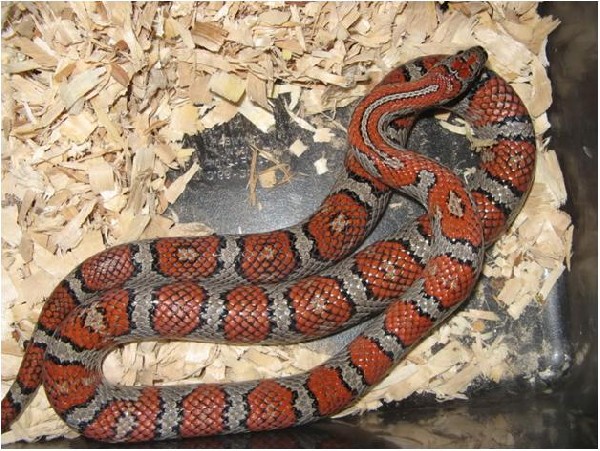
Gallery Photo by oregonherpaholic
Click to Enlarge |

Gallery Photo by makisfree
Click to Enlarge |

Gallery Photo by EDzExotics
Click to Enlarge |

Gallery Photo by vaclav
Click to Enlarge |
|
|
Sponsored Link
New & Updated Business Listings
Looking for a reptile or amphibian related business? A reptile store, breeder, importer,
maunfacturer or supplier? Our business directory lists some of the most popluar herp businesses in the world.
| Locate a reptile or amphibian business by name:
|
|
Recent Mexicana Kingsnakes Forum Posts
• HELP TOOTH STUCK?, posted by BlackMexicanKing
• HELP TOOTH STUCK?, posted by BlackMexicanKing
• HELP TOOTH STUCK?, posted by BlackMexicanKing
• "Imprinted" Thayeri?, posted by charlescory
• Does anyone know what Chris Baubel or..., posted by Patton
• hypo-e mex mex clutch all hatched, posted by sballard
• Hide size, posted by TacitGrunt
• Striped ruthven kings, posted by presentdaydino
• going wild, posted by stumble
• hypo-e mex mex, posted by sballard
• Thayers or Greers, posted by steeve111
• Email Change - Mike Bodner, posted by pikiemikie
• king snake question, posted by crmargolis
• "White" Thayeri ??, posted by ssshane
• Ruthveni, posted by HappyHeathen
Recent Mexicana Kingsnake Classifieds:
Banner Pool
KINGSNAKE.COM
Enjoy all our content free of charge with a user account that gives you full access to every feature.
For added visibility, paid options are available - post in our Classifieds, showcase your business with
Banner Ads or a Directory listing, promote reptile events, and more.
|
Quick Links
|
Community
|
Legal & Safety
|
Support
|
|
|
Kingsnake.com ® is a registered trademark © 1997-
|
|
|