


The hard-to-find glass lizard
By Richard Bartlett · April 21, 2015 5:39 am
Although eastern glass lizards, Ophisaurus ventralis, live in our yard, finding them on demand is a definite problem. I have never been able to do so yet! When it comes right down to it, whether I'm looking for them in my yard or elsewhere, I seldom succeed - at least on the first try.
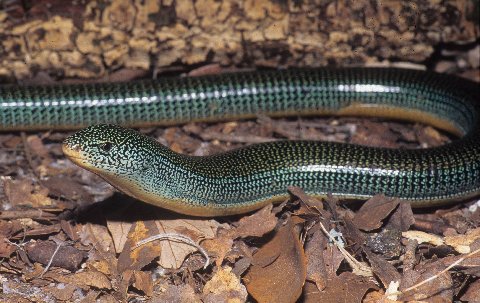
There are 4 species of glass lizard (family Anguidae) in the United States. Three of the four, the mimic, the island, and the eastern, are restricted to the Southeastern United States. The fourth, the slender glass lizard, has two subspecies. The eastern subspecies is found from Kentucky and Virginia to Louisiana and Florida. The western subspecies ranges from a disjunct population in Wisconsin to Nebraska (barely) and southward to south Texas and west Louisiana.
Glass lizards are accomplished burrowers. In addition to making their own burrows when substrate is of the proper consistency, they may enter and follow a burrow pre-made by a small rodent or large insect. They also often seek seclusion beneath surface debris.
I have been fortunate enough to have found four eastern glass lizards in our yard, three beneath sheets of tin or plywood and one found about 12 inches below the ground surface while I planted a tree. The island and the mimic glass lizards seem a bit less urbanized and are most often encountered in open sandy woodlands or meadows.
Despite being seldom seen, of the four American taxa in this genus of oviparous lizards, only the mimic glass lizard is considered uncommon.
Female glass lizards (such as this eastern) often remain with their eggs throughout the incubation. This young eastern glass lizard is typically colored and patterned.

 Author, photographer, and columnist Richard Bartlett is one of the most prolific writers on herpetological subjects in the 20th century. With hundreds of books and articles to their credit, Richard and his wife Pat have spent over four decades documenting reptiles both in the field and in captivity. For a list of their current titles, please visit their page in our bookstore. Author, photographer, and columnist Richard Bartlett is one of the most prolific writers on herpetological subjects in the 20th century. With hundreds of books and articles to their credit, Richard and his wife Pat have spent over four decades documenting reptiles both in the field and in captivity. For a list of their current titles, please visit their page in our bookstore. |